
If you’re arriving in Germany as an expat, securing the right health insurance is not optional — it’s a legal requirement. This article explains how to navigate the German health care system, compare public and private health insurance, and understand when you qualify for each. Whether you’re coming as an employee, freelancer, or student, this guide will help you get insured — and stay protected.
1. What is public health insurance and why it matters for expats
In Germany, the most common and traditional option is public health insurance. This system is part of the social welfare tradition: everyone who earns under a certain threshold 77.400€ or doesn’t meet private insurance requirements is covered by public insurance. For many expats arriving from abroad, public health insurance offers an accessible and regulated way to get health coverage.
If you qualify for public insurance, your monthly contribution depends on your income, not on your health status or age. Your employer typically pays half of the contribution if you’re employed. For families, public insurance may cover not only you but also your spouse and children. This makes public insurance particularly attractive lower income and for families with only 1 income.
Moreover, public health insurance provides standard but comprehensive coverage: doctor visits, hospital stays, basic dental care, surgeries, maternity care, and preventive services are included. For many expats, this standard coverage is enough for everyday health needs, but comes with restrictions and longer waiting times.
2. When can an expat choose private health insurance in Germany?
Not every expat automatically qualifies for private health insurance in Germany. There are specific conditions to meet. Generally, you can choose private insurance if one of the following applies:
Eligibility for private health insurance
Your gross annual income exceeds the “compulsory insurance threshold” (around €73,800 in 2025) — in that case, as an employee you become eligible for private health insurance.
You are self-employed, a freelancer, or a civil servant (Beamter).
Sometimes students or recent graduates may opt for private plans under certain conditions depending on age, prior insurance history and other factors.
If you meet these criteria, you have the option to switch from public insurance to private insurance, or to directly enroll in private coverage upon arrival. For many expats, this flexibility offers a way to tailor their health insurance to their needs and budget.
However, choosing private insurance is a decision that lasts — switching back to public health insurance later can be complicated or even impossible, especially once you cross certain age thresholds.
3. What is private health insurance and how does it work for expats
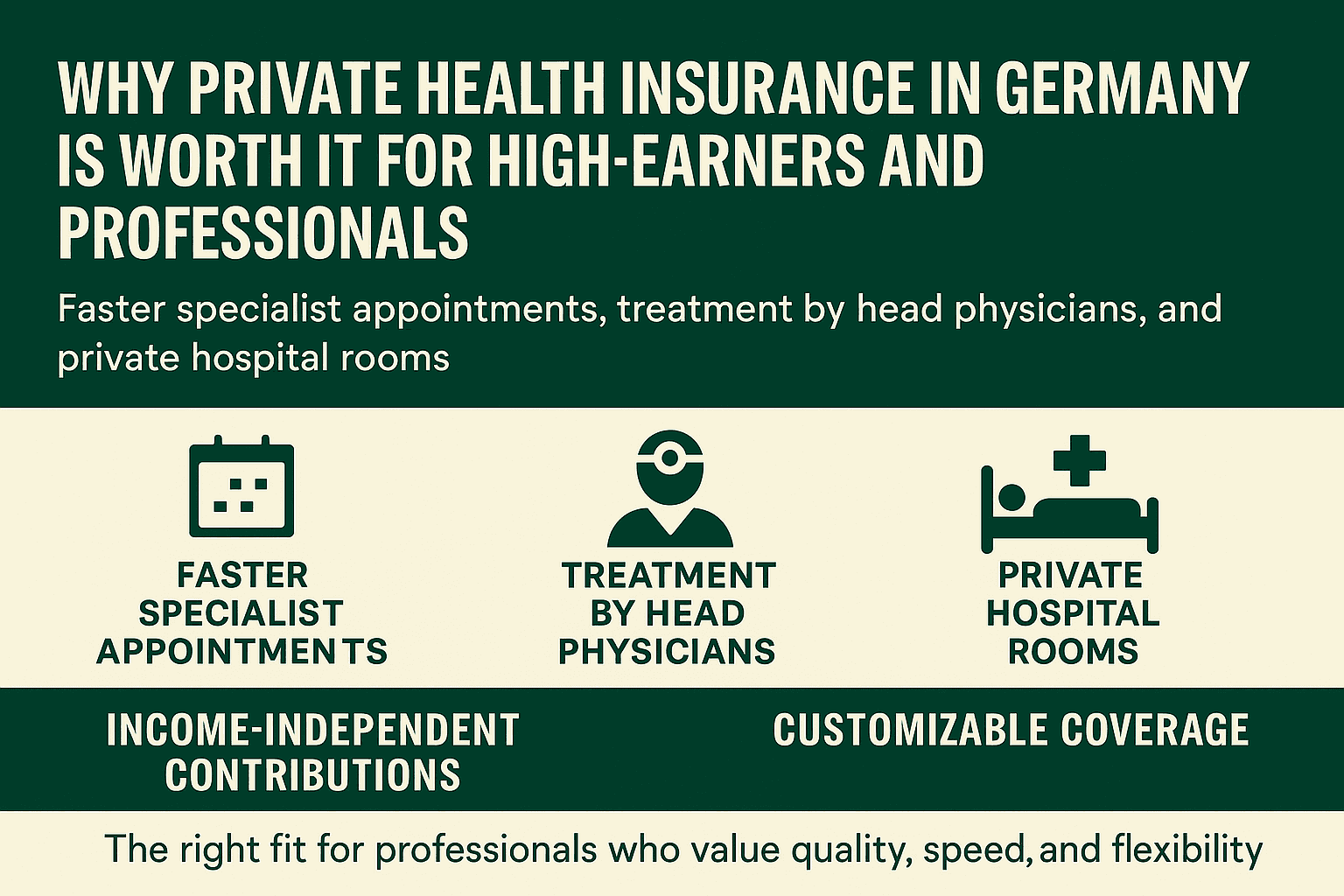
Private health insurance (often abbreviated PKV) offers a different model than public insurance. Instead of contributions based on income, your premium is calculated based on age, health status, and chosen coverage level. That means that high income employees often pay considerably less than for public insurance, while older or less healthy people may pay more.
With a private health insurance plan, you get more flexibility and often higher-quality services: shorter waiting times for specialists, access to private hospitals or private rooms, and broader coverage — including dental or advanced treatments depending on tariff. You can tailor the insurance plan to your needs, selecting or omitting extras like dental, private hospital rooms, or alternative therapies.
Features and flexibility of private insurance
With a private health insurance plan, you get more flexibility and often higher-quality services: shorter waiting times for specialists, access to private hospitals or private rooms, and broader coverage — including dental or advanced treatments depending on tariff. You can tailor the insurance plan to your needs, selecting or omitting extras like dental, private hospital rooms, or alternative therapies.
Private insurance can also include perks such as better reimbursement for medicines, outpatient treatments, or international coverage if you travel often. For expats who value high-quality care, flexibility, and convenience, a private insurer may be an appealing option.
¡Reserva tu consulta gratuita ahora!
El seguro de salud en Alemania puede ser sencillo. Nuestro amable equipo te ayuda a encontrar el plan de seguro de salud privado perfecto, ya seas empleado, autónomo o estés solicitando un visado. Obtén asistencia personalizada y tranquilidad.
4. Do you need immediate health insurance on arrival — even before employment or study begins?
Yes — when you move to Germany, you’re required to have valid health insurance from the moment you arrive, or at the latest when you apply for your visa or residence permit. That means, even before you get a job contract or start university, you must show proof of insurance.
If you don’t have employment yet, you can opt for temporary solutions: a travel health insurance or a special expat health insurance plan that covers the initial period. This temporary coverage is often accepted for visa applications and residence permit registration.
However, temporary or expat health insurance should be seen only as a stop-gap. Once you start working or settle long-term, you should switch to a standard public or private health insurance plan. This ensures full coverage and compliance with German health insurance regulations.
Relying solely on short-term travel or expat plans for long-term living in Germany is risky — these plans often have limitations and may not be sufficient in case of serious illness or hospital stays.
5. What is expat health insurance / international health insurance for newcomers
“Expat health insurance” or “international health insurance” usually refers to a temporary, private insurance plan designed for newcomers who arrive in Germany (or any foreign country) and haven’t yet settled. It fills the gap between arrival and when you can register for public or private insurance in Germany.
Use cases and limitations
This type of insurance is often used by expats during visa application, city registration, looking for accommodation or a job, or waiting for formalities to complete. It’s a quick and easy way to get insured and satisfy visa requirements immediately after arrival.
Such plans typically cover emergency medical treatment, hospital stays, sometimes basic dental or outpatient care. However, benefits are usually more limited compared to regular public or private insurance in Germany, and tariffs can be less favorable if used long-term.
That’s why expat health insurance and international plans are best used as a transition — just until you register with a proper German health insurer and sign an official health insurance contract.
6. Public vs. Private: which insurance makes sense for you as an expat?
Deciding between public and private insurance depends on your personal and family situation, income level, plans for the future — and your tolerance for risk, cost, and flexibility.
When public health insurance makes sense:
Your income is moderate or you expect it to stay moderate.
You have a spouse or children who need coverage — in public insurance, dependents often get covered at no additional cost.
You prefer stable, predictable costs and protection against premium increases with age or illness.
You don’t need luxury perks, and standard German doctor and hospital care is sufficient.
When private health insurance may be worth it:
You earn above the compulsory threshold, or you are self-employed/freelancer with stable income.
You value quick access to specialists, private hospitals or enhanced services.
You travel often or want extended coverage (e.g. international health insurance, coverage abroad).
You are young, healthy, and comfortable managing rising premiums as you age.
Potential drawbacks to consider:
Private plans often exclude free coverage for family members — each person needs their own tariff.
Premiums may increase each insurance year, due to age or health.
Switching back to public health insurance later may be difficult.
For expats aiming for long-term residence or wanting to start a family, public insurance may offer better long-term stability and coverage.
7. What to consider when choosing dental, add‑ons, and tariffs in private insurance plans
If you opt for private health insurance, you’ll often need to customize your health insurance plan via tariffs and add-ons. Key points to check:
Important plan components
Dental insurance or coverage for dental care: Basic public plans often include minimal dental coverage; private plans can offer enhanced dental care, orthodontics, high-quality prosthetics, or regular check-ups. Decide whether you want basic or premium dental care.
Deductible (Selbstbeteiligung): Lower premiums may mean higher deductibles — meaning you pay more out-of-pocket before full coverage. Evaluate how often you expect to use medical services to decide the right deductible level.
Hospital and treatment options: Some tariffs offer private or semi-private rooms, choice of specialist, or quicker appointments. If you value comfort and speed, a higher-tier tariff may be worth it.
Waiting periods and terms and conditions: Often private insurance comes with waiting periods for certain services, or conditions tied to length of stay. Read the policy carefully to know when coverage begins and what is included.
International or travel coverage: If you travel frequently or plan to spend time outside Germany, check whether your insurer offers global health insurance or coverage abroad.
Choosing the right tariff and options is crucial — a low-cost plan might not provide adequate coverage, while a premium plan may be costly. Consider your health needs, frequency of care, and long-term plans before committing.
¡Reserva tu consulta gratuita ahora!
El seguro de salud en Alemania puede ser sencillo. Nuestro amable equipo te ayuda a encontrar el plan de seguro de salud privado perfecto, ya seas un empleado, autónomo o si estás solicitando un visado. Obtén asistencia personalizada y tranquilidad.
8. How to register for health insurance — visa, residence permit and documentation requirements
Registering for health insurance in Germany requires some paperwork — but the process is generally straightforward if you have your documents ready.
Registration scenarios
If you’re employed: your employer will often help you register with a statutory health insurance fund (public) or deduct your private insurance contributions. Once registered, you receive an insurance certificate and often an insurance card — essential for doctor visits, prescriptions, or hospital stays.
If you’re applying for visa or residence permit: you’ll need to prove you have valid health insurance from the start of your stay. Often, a temporary expat or travel insurance is accepted during the visa application phase — but you must convert to a regular plan once you begin working or settling down.
Documentation typically required: passport or ID, German address registration (Anmeldung), work contract or proof of income, details of dependents if any, and selection of either public or private insurer if applicable.
Once your insurance contract is finalized, coverage generally starts immediately — but check whether there is a waiting period, especially for private insurance tariffs.
9. What self‑employed expats and freelancers need to know about health insurance in Germany
If you arrive in Germany as a self-employed individual or freelancer, you won’t be automatically enrolled in public insurance. Instead, you must proactively choose between public or private health insurance.
Private insurers will often evaluate health status, age, expected income stability, and possibly conduct a medical examination before accepting you. Because of varying income as freelancer, it’s important to choose a tariff that you can afford even in lean months.
Under public insurance, contributions may fluctuate with your declared income — this can give you flexibility in months with low income. But public insurance often comes with less flexibility and longer wait times for services.
Also consider long-term plans: if your freelance career fluctuates, will you still afford private premiums when you earn less? Or will public insurance’s income-based contributions give you more safety? Think about worst-case scenarios, not just current income.
10. Frequently Asked Questions: common expat concerns about health insurance
Do I need health insurance as soon as I arrive in Germany?
Yes — German law requires that everyone residing in Germany has valid health insurance. For visa or residence permit applications, you often must show proof of coverage.
Can I use my home country insurance while living in Germany?
Only in certain limited cases — e.g. temporary visits, EU insurance with EHIC, or very short stays. For long-term residence, you need a German health insurance plan.
Is private health insurance always better than public?
Not necessarily. Private insurance offers more flexibility, faster service, and often better amenities — but it's more expensive, may rise in cost over time, and doesn’t automatically cover family members. Public insurance offers affordability, family coverage, and stable benefits.
What happens if I don’t have health insurance in Germany?
Without valid insurance, you’ll face legal and financial risk. You may be denied visa approval, residence permit, or even access to medical services. In case of illness or accident, the cost can be catastrophic.
Can I start with expat health insurance and later switch to public or private?
Yes — many expats begin with a temporary expat health insurance plan. Once they settle, get a job or income, they switch to a regular public or private health insurance plan. It’s recommended not to rely on expat insurance for long.
📝 Key Takeaways
Health insurance is mandatory in Germany — every expat must be insured.
You can choose between public health insurance and private health insurance (PKV) depending on income, status, and needs.
Many expats start with a temporary expat health insurance right after arrival — particularly useful for visa and residence permit application.
Public insurance: predictable costs, family coverage, no health checks. Great for stable long-term living and families.
Private insurance: customisable tariffs, better amenities, faster access. Ideal for high earners, singles, or those valuing flexibility.
For private plans: check dental, deductible, tariff level, waiting periods, and family coverage carefully.
Self-employed expats and freelancers must consider income fluctuations before choosing private insurance — and may prefer public insurance for stability.
Always have valid insurance in place before applying for visa or residence permit.
Compare insurance plans, read the terms and conditions, and consider long-term costs and benefits — not just short-term convenience.
Preguntas frecuentes
¿Puedo volver al seguro médico público?
¿Aumentan las primas del seguro de salud privado con la edad?
¿Pueden las compañías de seguros de salud privados cancelar contratos en caso de enfermedad?
¿Tengo que pagar las facturas del médico por adelantado?
Resumen de beneficios: Seguro público versus privado en Alemania
¿Quién puede acceder al seguro de salud privado?
¿Cuáles son las ventajas de un seguro de salud privado en cuanto a la cobertura?
¿Cuáles son las principales ventajas del seguro privado frente al seguro público?
¿Cuáles son las principales ventajas del seguro privado frente al seguro público?
¿Cuáles son las principales ventajas del seguro privado frente al seguro público?
¡Reserva tu consulta gratuita ahora!
El seguro de salud en Alemania puede ser sencillo. Nuestro amable equipo te ayuda a encontrar el plan de seguro de salud privado perfecto, ya seas empleado, autónomo o estés solicitando un visado. Obtén asistencia personalizada y tranquilidad.